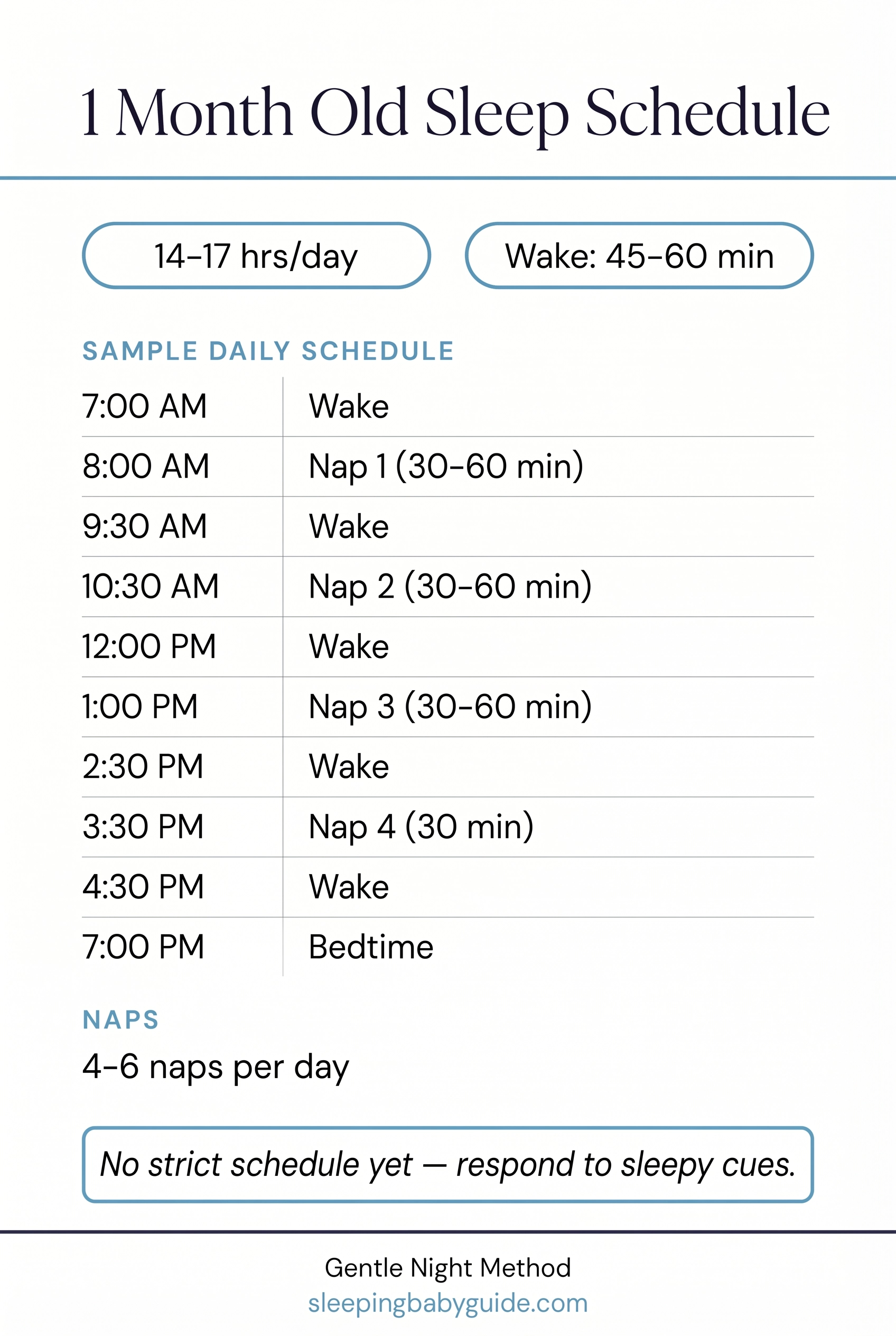
At one month, your baby is beginning to have slightly longer wake windows than the newborn stage, but sleep is still very fragmented. Most 1-month-olds can stay awake for 45 to 75 minutes before showing sleepy cues. The circadian rhythm is just beginning to develop, so you may start to see slightly longer stretches at night. An eat-play-sleep rhythm (feed, brief wake time, then sleep) works well at this age.
Total Sleep
15 to 17 hours
Naps
4 to 5 naps
Wake Window
45 to 75 minutes
Bedtime
9:00 PM to 10:30 PM
Night Feeds
Every 2.5 to 3.5 hours
This is a sample schedule based on a 7:00 AM wake time. Shift all times proportionally if your baby wakes earlier or later.
| Time | Activity |
|---|---|
| 7:00 AM | Wake and feed |
| 8:00 AM | Nap 1 |
| 9:30 AM | Wake and feed |
| 10:30 AM | Nap 2 |
| 12:00 PM | Wake and feed |
| 1:00 PM | Nap 3 |
| 2:30 PM | Wake and feed |
| 3:30 PM | Nap 4 |
| 5:00 PM | Wake and feed |
| 6:00 PM | Catnap (30 to 45 min) |
| 7:30 PM | Wake and feed |
| 9:30 PM | Bedtime feed and settle |
| 12:30 AM | Night feed 1 |
| 3:30 AM | Night feed 2 |
| 6:00 AM | Early morning feed |
Watch for sleepy cues: yawning, eye rubbing, staring blankly, turning head away.
An eat-play-sleep rhythm helps prevent feeding-to-sleep associations from forming.
A brief bedtime routine (dim lights, swaddle, feed, white noise) begins to signal sleep.
Night feeds should be calm and dark to reinforce the difference between day and night.
Tummy time during wake windows supports development and tires babies appropriately.
The Newborn Sleep Guide covers everything in this schedule plus detailed gentle methods, troubleshooting, and real-life scenarios.
Most 1-month-olds take 4 to 5 naps per day. Nap lengths vary from 30 minutes to 90 minutes. Longer naps are normal and healthy at this age.
A loose bedtime between 9 PM and 10:30 PM is appropriate. Earlier bedtimes (before 8 PM) are not recommended until around 3 to 4 months when the circadian rhythm matures.
Most 1-month-olds can comfortably stay awake for 45 to 75 minutes. Exceeding this leads to overtiredness, which makes it harder to fall and stay asleep.