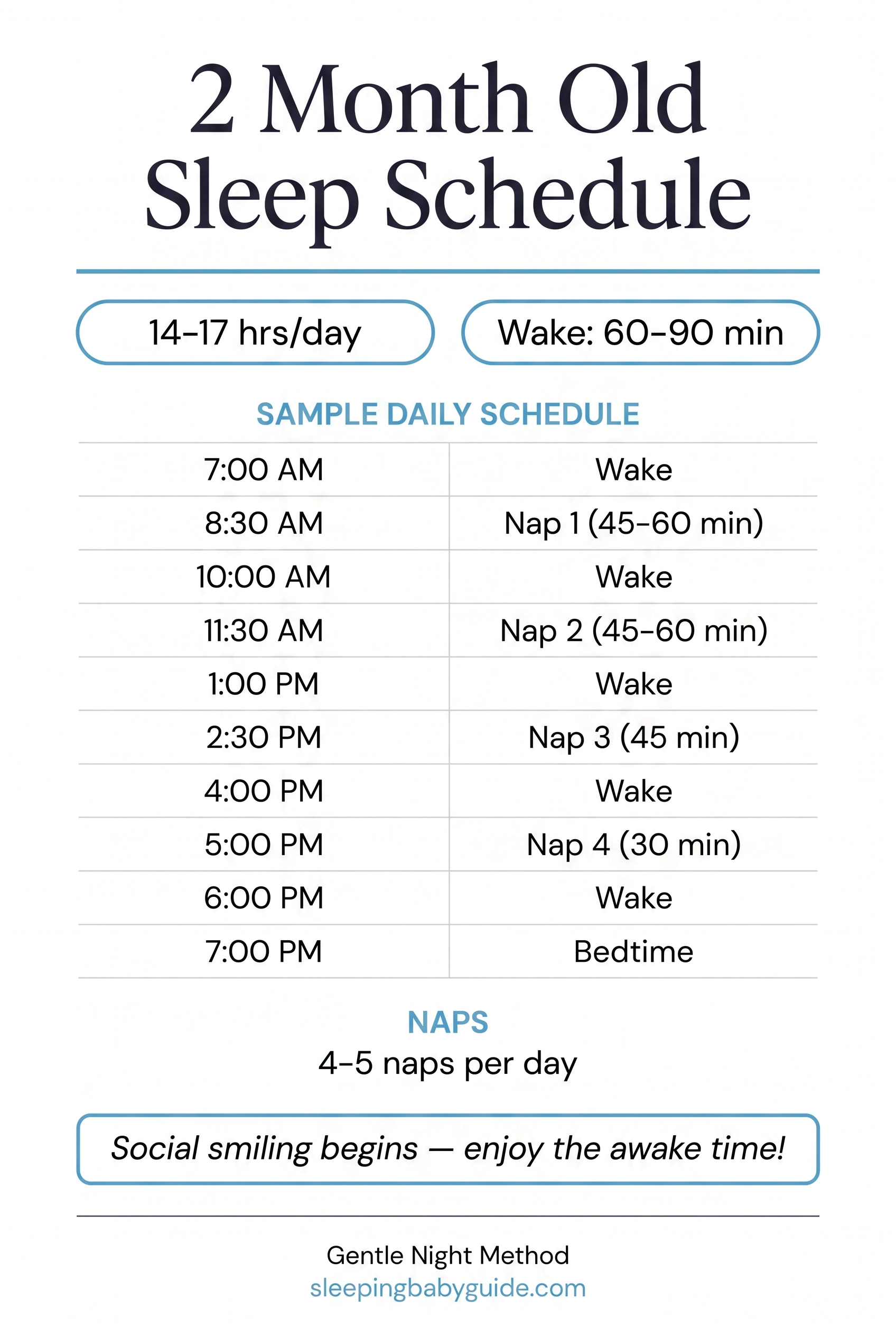
At two months, many babies begin to show a more predictable pattern. Wake windows stretch to 60 to 90 minutes, and you may notice your baby starting to have one longer stretch of sleep at night (sometimes 3 to 5 hours). The social smile appears around this age, making wake windows more interactive. An eat-play-sleep rhythm continues to work well.
Total Sleep
14 to 16 hours
Naps
4 to 5 naps
Wake Window
60 to 90 minutes
Bedtime
8:30 PM to 10:00 PM
Night Feeds
2 to 3 times
This is a sample schedule based on a 7:00 AM wake time. Shift all times proportionally if your baby wakes earlier or later.
| Time | Activity |
|---|---|
| 7:00 AM | Wake and feed |
| 8:15 AM | Nap 1 |
| 10:00 AM | Wake and feed |
| 11:15 AM | Nap 2 |
| 1:00 PM | Wake and feed |
| 2:15 PM | Nap 3 |
| 4:00 PM | Wake and feed |
| 5:15 PM | Nap 4 (short catnap) |
| 6:30 PM | Wake and feed |
| 8:30 PM | Bedtime routine: bath, feed, swaddle, white noise |
| 9:00 PM | Bedtime |
| 1:00 AM | Night feed 1 |
| 4:00 AM | Night feed 2 |
If your baby is doing a long first stretch at night, protect it by not waking them for a dream feed unless advised by your pediatrician.
Begin a consistent bedtime routine: bath, massage, feed, swaddle, white noise. Consistency matters more than timing at this age.
Drowsy but awake is worth practicing at this age but do not stress if your baby needs more support.
Nap lengths are still variable. Short naps (30 to 45 min) are normal and will lengthen over time.
The Newborn Sleep Guide covers everything in this schedule plus detailed gentle methods, troubleshooting, and real-life scenarios.
No. Sleeping through the night is not developmentally expected at 2 months. Most 2-month-olds still need 2 to 3 night feeds. Some may do one longer stretch of 4 to 5 hours.
Most 2-month-olds take 4 to 5 naps per day. The total daytime sleep is around 5 to 6 hours.
Between 8:30 PM and 10:00 PM is typical. Earlier bedtimes are not recommended until the circadian rhythm matures around 3 to 4 months.