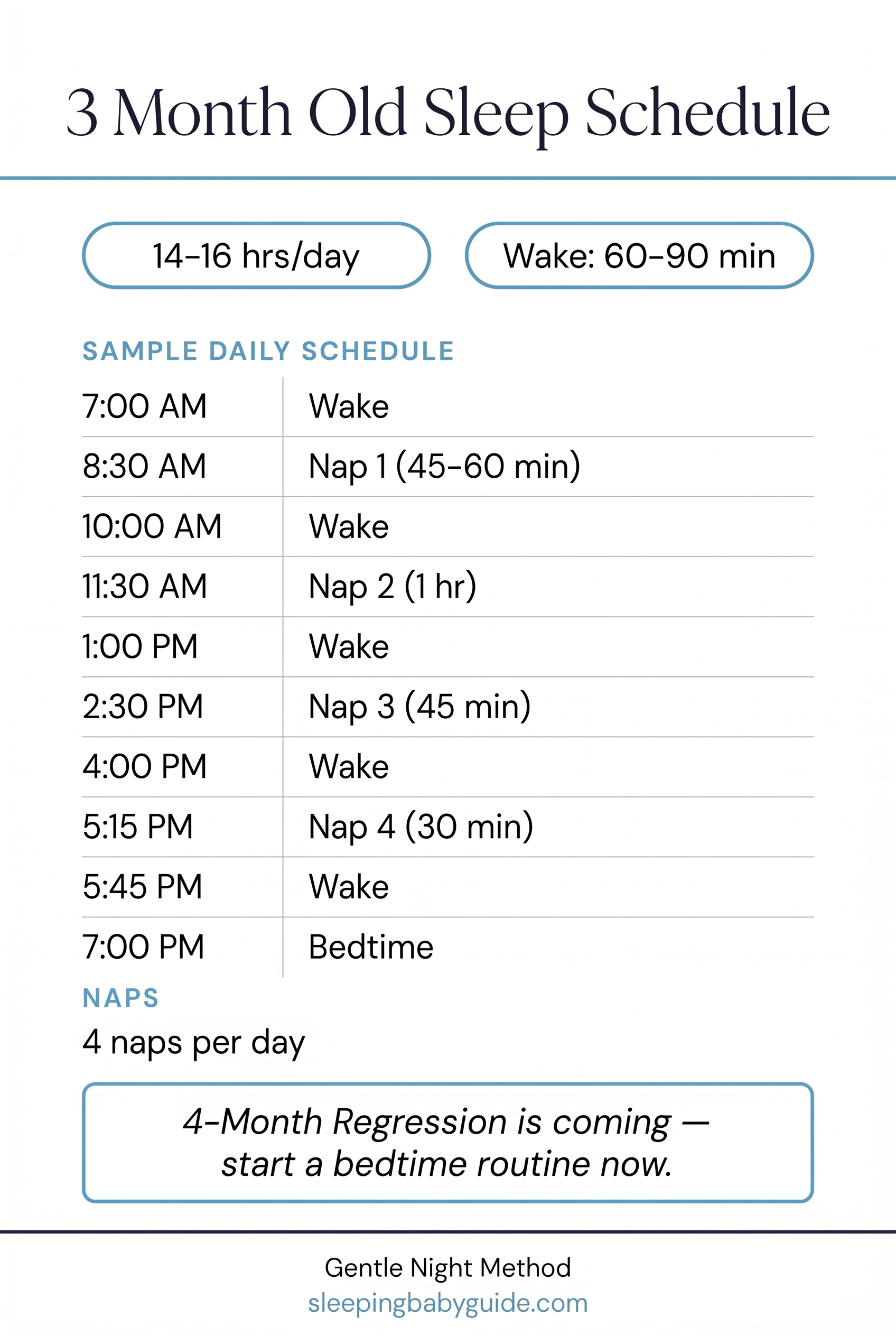
Three months is a transitional age. The circadian rhythm is maturing, bedtimes are moving earlier (7:30 PM to 8:30 PM), and many babies consolidate from 5 naps to 3 to 4 naps. Some babies begin doing a longer overnight stretch of 6 to 8 hours. This is also the age to start preparing for the 4-month sleep regression, which typically hits between 14 and 19 weeks.
Total Sleep
14 to 16 hours
Naps
3 to 4 naps
Wake Window
75 to 105 minutes
Bedtime
7:30 PM to 8:30 PM
Night Feeds
1 to 2 times
This is a sample schedule based on a 7:00 AM wake time. Shift all times proportionally if your baby wakes earlier or later.
| Time | Activity |
|---|---|
| 7:00 AM | Wake and feed |
| 8:30 AM | Nap 1 |
| 10:00 AM | Wake and feed |
| 11:30 AM | Nap 2 |
| 1:00 PM | Wake and feed |
| 2:30 PM | Nap 3 |
| 4:00 PM | Wake and feed |
| 5:15 PM | Catnap (30 to 45 min) |
| 6:00 PM | Wake and feed |
| 7:30 PM | Bedtime routine: bath, feed, white noise |
| 8:00 PM | Bedtime |
| 2:00 AM | Night feed (if needed) |
| 5:00 AM | Early morning feed (if needed) |
Move bedtime earlier as wake windows lengthen. A 7:30 PM to 8:00 PM bedtime is appropriate now.
Begin practicing a consistent 3 to 4 step bedtime routine every night.
The 4-month sleep regression is coming. It is not caused by anything you do wrong — it is a neurological milestone.
Naps may become shorter or more unpredictable as the regression approaches. This is normal.
The 3 to 4 Month Sleep Guide covers everything in this schedule plus detailed gentle methods, troubleshooting, and real-life scenarios.
The 4-month regression can begin as early as 10 to 12 weeks. Signs include increased night waking, shorter naps, and difficulty settling. It is a normal neurological development.
Most 3-month-olds take 3 to 4 naps per day, totaling 4 to 5 hours of daytime sleep.
Between 7:30 PM and 8:30 PM is ideal. Earlier bedtimes reduce overtiredness and often lead to better overnight sleep.