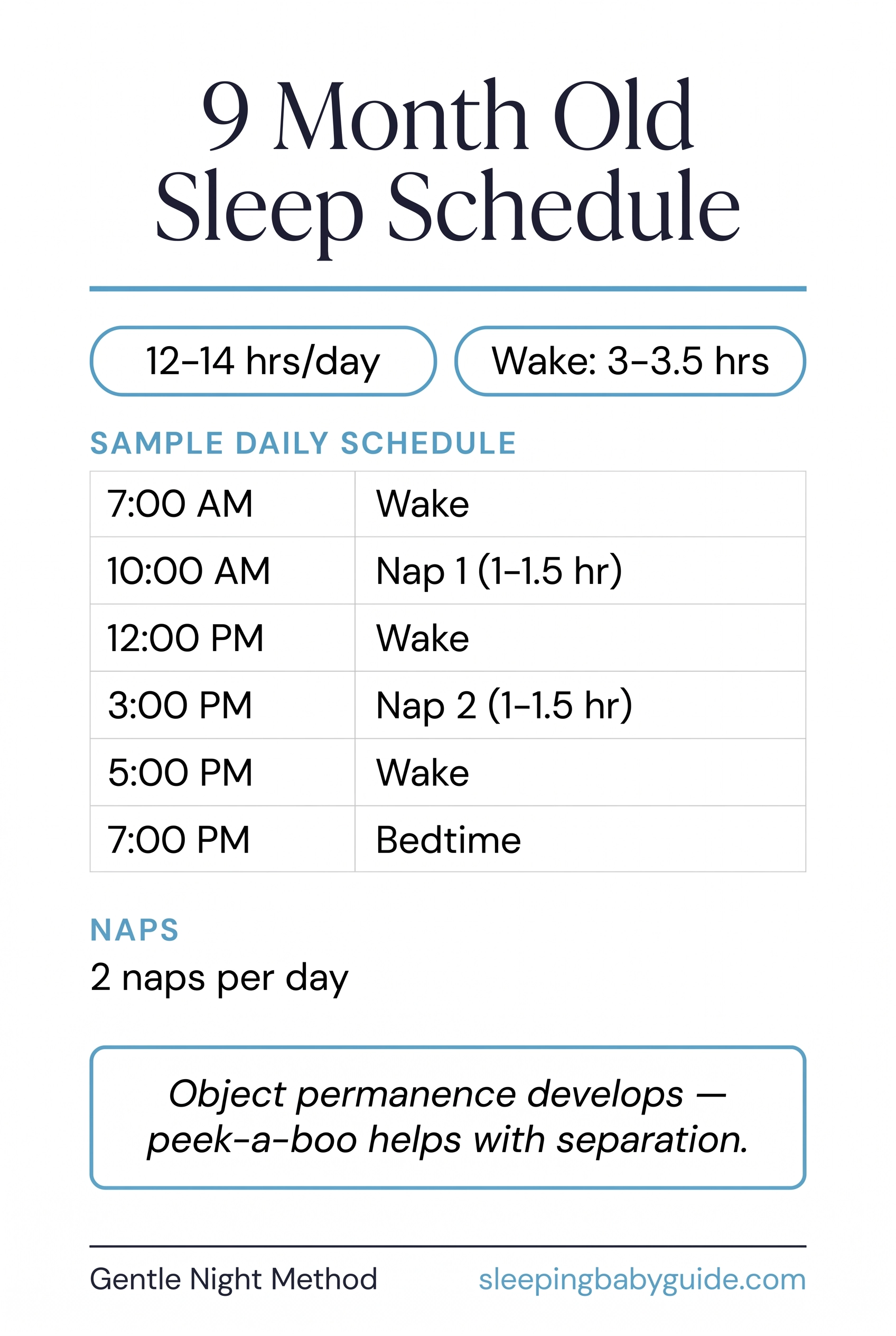
At nine months, wake windows stretch to 2.75 to 3.25 hours and the 2-nap schedule is well established. The 9-month sleep regression is closely linked to the 8-month regression and is driven by continued developmental leaps. Many babies are now crawling, pulling to stand, and beginning to cruise. Object permanence is fully developed, which can intensify separation anxiety.
Total Sleep
12.5 to 14 hours
Naps
2 naps
Wake Window
2.75 to 3.25 hours
Bedtime
6:30 PM to 7:30 PM
Night Feeds
0 times
This is a sample schedule based on a 7:00 AM wake time. Shift all times proportionally if your baby wakes earlier or later.
| Time | Activity |
|---|---|
| 7:00 AM | Wake and feed |
| 9:45 AM | Nap 1 (60 to 90 min) |
| 11:15 AM | Wake and feed |
| 2:15 PM | Nap 2 (60 to 90 min) |
| 3:45 PM | Wake and feed |
| 6:45 PM | Bedtime routine |
| 7:15 PM | Bedtime |
The last wake window (3 to 3.25 hrs) is the longest. Do not put your baby to bed too early or they will wake early.
Finger foods and self-feeding during mealtimes support development and tire babies appropriately.
If naps are consistently short (under 45 min), check wake windows — they may need to be longer.
The 9 to 12 Month Sleep Guide covers everything in this schedule plus detailed gentle methods, troubleshooting, and real-life scenarios.
Yes. The 9-month regression overlaps with the 8-month regression and is driven by major developmental leaps in mobility and cognition. It typically lasts 2 to 6 weeks.
Two naps per day, each 60 to 90 minutes, for a total of 2.5 to 3 hours of daytime sleep.
Most babies transition from 2 naps to 1 nap between 14 and 18 months. Transitioning before 12 months is generally too early.